






Date:
17 November 2022, 19:30 Thursday
Place:Madrid, CentroCentro
VANG V. Fatima Miranda
Nooks
VANG V. Avant-garde music
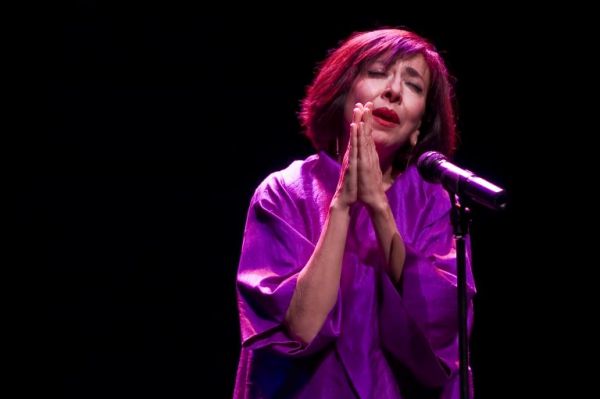
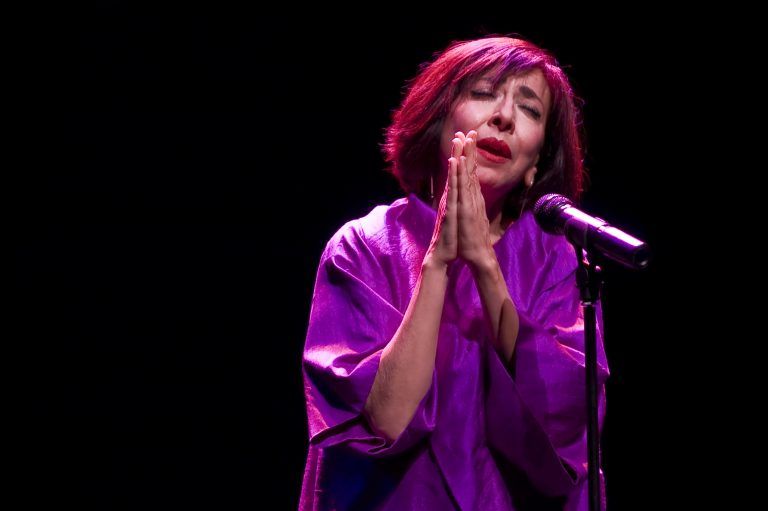
"This is an intimate concert-performance for solo voice. A SINGLE BODY. Trained muscles sculpting the air with an extended voice used as a wind and percussion instrument on an unusual and extreme register. On a more than sober scenic space, the contemplative, melancholic, dramatic, ritual or crazy, harmonizes the everyday, the popular and the sublime, trying to induce an imaginative and critical vision of reality and provide a liberating terrain from the insane fondness for the comfort and torpor that guarantee the known and the classifiable. Today more than ever it is up to the artist of any discipline to contribute content that can never be alienated from its essence or be emptied of its original meaning by the avid adversary, a specialist in monetizing and converting the noble and ingenious initial flight of so many into merchandise and entertainment. . RECOvECOS won't give you that taste.
What is often understood as art is opposed to the meaning of poetry and its reason for being. The avant-garde of law builds work (visual, literary, movies, music, choreography, performances, etc.) that does not allow itself to be manipulated by the dominant thought. It prevents being used as an instrument at the service of the former. Only in this way is the poetic scope of the work transformative and propitious for those who contemplate it, opening of mind, eyes and ears as well as an awakening of reflections and enjoyment.
As far as art is concerned, critical thinking, not gregarious thinking, is imperative. Any work worth its salt must be devoid of fear of difference and unconcerned about the search for security and certainty in favor of what is authentic and what stirs without adornment or artifice. Immerse yourself in the dark corners, in the dusty corners, in the relegated belongings, in the sometimes brilliant and sometimes absurd ideas that clutter drawers, shelves and stacked notebooks or in lists of tasks whose urgency had faded between consecutive agendas. Doing it with the certainty that in its twists and turns there will be particles of refractory and inalienable poetry in the face of the powerful tricks of those who want us camouflaged or light, gives us not only a nice and fun lightness but also the guarantee of being abyssed without any risk of breaking our necks .
An act of faith, yes, generator, between numerous and tireless work, irrepressible smiles. It is an exercise in cleaning to allow the lost, the lost, the hidden, the cornered, the postponed, the initially dispensable or the not dazzling or too technical or virtuous to emerge into the light. The hidden is often what gives light. Taking it out of its corner and airing it is little less than airing the insides without dramatizing or giving itself greater importance, cleaning up notebooks and memories and providing them with an entity, like objets trouvés that one of those hygiene days, find their meaning until then ignored... or crouched in the unidentified or procrastinated ins and outs. Such a practice also provides the opportunity to reveal openly. RECOvECOS, combining previous work and new work, between restrained and daring, devoid of useless fears, reactivates and sings those echoes.
There they go." Graduated in History of Art, composer, singer and researcher of the voice and vocal music of traditional cultures, daughter of an ethnominimal sensitivity, since 1983 Fátima Miranda has carried out research work on the voice and vocal music of traditional cultures . Fleeing from comfortable stereotypes, she combines Eastern and Western vocal techniques and those of her own invention, conceiving the voice as a wind and percussion instrument installed in her own body. This has allowed him to develop a register of more than four octaves that he puts at the service of his own musical language in which the borders between singing, poetry, theater, composition, improvisation and interpretation are blurred. In her concerts, a single voice, in symbiosis with a significant poetic, gestural, visual, dramatic and humorous component, moves us to the depths.
She is a founding member since 1983 of the improvisation group Taller de Música Mundana in which she collaborates with Llorenç Barber, she also creates a phonetic poetry group with the Flatus Vocis Trio. With these groups she recorded two LPs: Opera para papel and Grosso Modo, respectively. Between 1982 and 1989 she directed the sound library of the Complutense University of Madrid. In 1985 she received the National Prize for Culture and Communication granted by the Ministry of Culture for her book La Fonoteca.
In 1987-1988 she studied Nô singing in Paris with Yumi Nara and learned Mongolian voice singing with Tran Quang Haï. Starting in 1987, she studied classical music from North India – Dhrupad singing – with several members of the eminent Dagar Family, Ustad Zia Fariduddin Dagar, Ustad Zia Fariduddin Dagar and Uday Bhawalkar. Between 1983 and 1993 she studied bel canto in order to put some and other techniques usually considered incompatible, in rica coexistence with the avant-garde. During the nineties he created three performance-concerts for solo voice: Las Voces de La Voz (1991), Concierto en Canto (1995), ArteSonado (2000), all three released on CD.
In 2005 he premiered the large format show Cantos Robados and in 2011 perVERSIONES, both released on DVD. In 2007 he premiered MADrid MADrás MADrid!. In 1996 she receives the prestigious DAAD scholarship, being invited by the Berliner Künstlerprogramm des Deutscher Akademischer Austauschdienst, as an artist in residence in the city of Berlin. In 2009 she received the II Cura Castillejo Award for the most outrageous Musical Proposal and the IV Demetrio Stratos Intenazionale Award. In 2012 she received the First Prize for Video Art from Women Artists at the VII International Art and Gender Encounters in Seville. In 2018 she is distinguished with the Gold Medal for Merit in Fine Arts. In 2013 she studies traditional Mugham singing with Fargana and Alim Qasimov in Azerbaijan. In November 2014 she premiered the concert-performance aCuerdas, a duet with the hurdy-gurdy virtuoso Marc Egea.
Since 2016 she has been developing the Living Room Room project, a cappella and tailor-made concerts for all kinds of public or private spaces, small or huge, devoid of theatrical structure, often without amplification. From museums, balconies, halls or churches to industrial buildings, including improvised sections that arise in dialogue with the public and with the architecture and acoustics that each place has. Fátima Miranda has collaborated, among others, with Llorenç Barber, Robert Ashley, Wolf Vostell, Jean-Claude Eloy, Julio Estrada, Stefano Scodanibbio, Bartolomé Ferrando, Pedro Elías, Markus Breuss, Bertl Mutter, Rachid Koraichi, John Rose, Hans Peter Kuhn, Stéphane Abboud, Werner Durand, Mirella Weingarten, Sacha Waltz, Yuval Avital, Chema Madoz, Baró D'Evel Cirk.