


Date:
23 October 2025 - 20 September 2026
Place:Madrid, CentroCentro
Miluca Sanz
Strata. The immortality of the ephemeral
Madrid in strata
Time slips through our fingers, and for years, Miluca Sanz has been trying to capture those fleeting moments that calendars can never hold back: “A calendar is like a path, it’s a way of making sense of the world; of cutting through life just as a path cuts through the landscape”, she says.
Miluca pursues the calendar in Madrid because here, more than anywhere else, the ephemeral becomes immortal through the triumph of everyday life - the very essence of the city and its comings and goings - that the people of Madrid cherish. These are the strata that Madrid offers those who are ready to embrace whatever the city might throw at them. Something that Ramón Gómez de la Serna expressed with extraordinary lucidity in his autobiography Nostalgias of Madrid, written during the time spent in exile in Buenos Aires: “For souls in perpetual torment, Madrid is a lovely place in which they can live happily (....) Achieving the immortality of the ephemeral”.
Miluca Sanz therefore sets to work in an effort to domesticate this calendar time - the calendar as a symbolic representation of time - and the layers that accumulate in the sediment of what we have lived and have yet to live. Because if a calendar is full of the past, it is equally full of the future as well. Then, well aware that she is never going to actually hold it back, the artist considers freezing time in photos - people leaving a concert, visiting a museum, rushing home in the rain… Or just strolling aimlessly through the streets, the privilege of the flâneur. An exorcism against the oblivion of the ephemeral, Sanz is obsessed with what she calls this “liquid time”: she doesn’t want time to slip through her fingers in those places that, if you think about it, could only be Madrid. Or not.
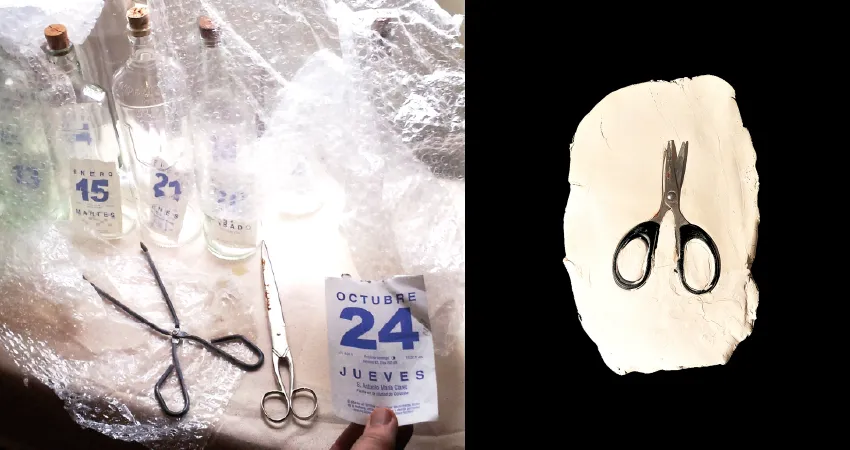
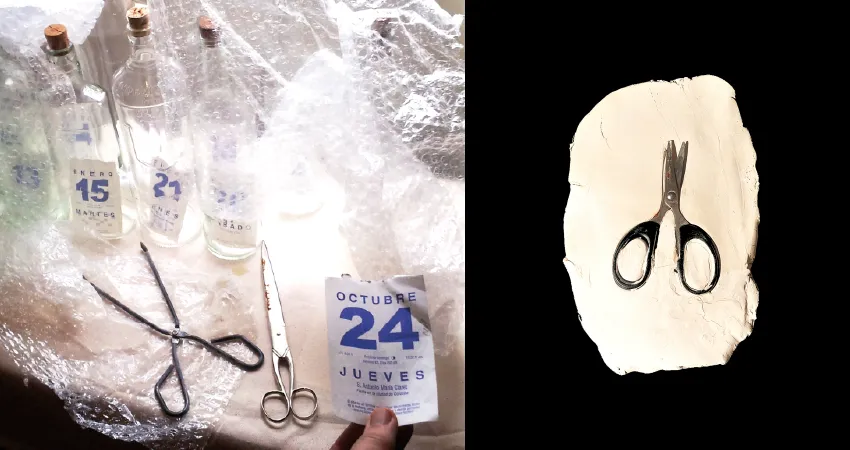
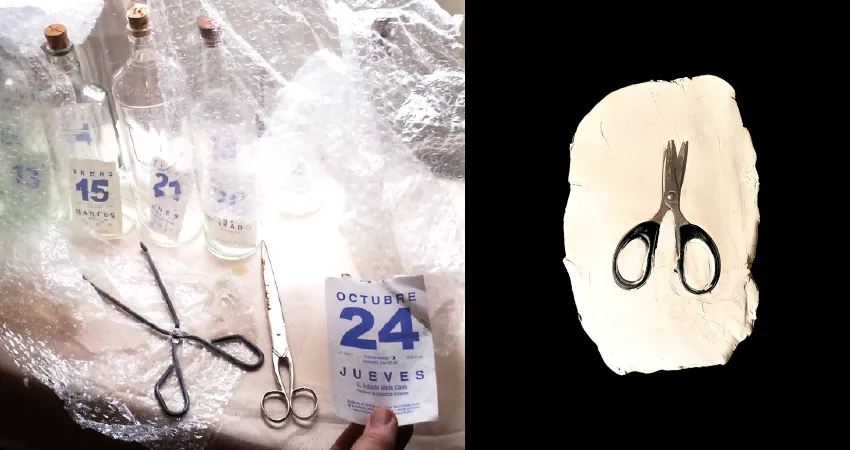
The Myrga calendar in her hand - which someone gives the collector - is a pad of time that’s torn away, sheet by sheet, marking the rhythm of life as it too slips away and becoming a kind of witness of the event. Only the torn sheet, held by the protagonist of the diary, the artist herself, acts as a reminder of that unique “there and then” that can only exist on that date and in that place. It is a clue, a sign for archaeologists of the future: We were here. The photographs flicker across the screen at a hectic pace, with no set order or subversion of the calendar. Time and space intertwine - perhaps only to cancel one other out.
The strata begin to emerge, obstinate vestiges of what remains, without us even noticing. And it is there, right there, in the materiality of those unexpected layers , that the archaeological manoeuvres of Miluca Sanz’s Madrid is highlighted. Her installation of relics devoid of hierarchies - following the order of the entire page devoted to July 2025 and trapped like Warhol’s time capsules (bones, bottles, a piece of a drain with some Roman remains, the concrete and the abstract) - rescues these everyday Madrid objects, the eternity of the ephemeral. Each one has its correlative in one of the projected images, the ones that show the hand holding the calendar. And this is where Miluca’s game comes into play: we, as spectators, will have to become archaeologists and find the associations. An authentic detective story worthy of Agatha Christie.
The painter Miluca Sanz (Segovia, 1956), lives and works in Madrid. She graduated in Art History from the Complutense University of Madrid, where she also obtained a PHD, a Diploma of Advanced Studies (DEA), and a master’s degree in Research in Art and Creation from the Faculty of Fines Arts of the same university. She is currently preparing her doctoral thesis on Diaries, Dates and Calenders.
Since the 1980s, she has held numerous solo exhibitions, including: Stones, Diaries and Other Natures, The Diaries of Others, The Diary of a Photo, The Smile of the Snails, Silence in Painting. She has also participated in collective exhibitions such as The History and Mystery of a Collection: MAC, Panorama 2023, The Movida Movement, Journeys with the Marquis, The Verne Cabinet, A State for Rent, and The Colours of Music.
Her work has been displayed in galleries such as EspacioValverde, Sen, Moriarty, and El Caballo de Troya; as well as at institutions such as the ABC Museum, Matadero Madrid, Círculo de Bellas Artes, and the Museum of Romanticism. She has created a wide range of artistic actions, videos and other projects, including: Buried Diaries, Everyday Diary, Burnt Diary (St. John), Diary of Strangers. Her work can be found in public collections such as the Creators Archive at the MUSAC and the Municipal Museum of Madrid, as well as in numerous private collections, such as La Caixa’s Testimony Collection.
Her work is imbued with several other interests and disciplines: music (she played keyboards for the Las Chinas pop group), books, conversations, workshops, round tables, and pecha-kuchas. Her work and indeed her life are a veritable collage of nature, dates and diaries, always viewed through the eye of a painter.
The exhibition curator is Estrella de Diego (Madrid, 1958). Estrella de Diego is an essayist, Professor of Art History at the Complutense University of Madrid, and a full member of the Royal Academy of Fine Arts (Académica de Número). She has held the post of Professor of Spanish Civilization at the KJCC at NYU, and the 13th Luis Ángel Arango International Chair of Art promoted by the Bank of the Republic of Bogotá. She is an Ida Cornelia Beam Distinguished Professor at the University of Iowa and was a recipient of a Fulbright Scholarship from NYU. She has been a member of the Advisory Committee of the Collegium for Advanced Studies at the University of Helsinki and has served as a patron of the Reina Sofía Museum, the Carolina Foundation, the Cervantes Institute, and the Spanish Academy in Rome.
She is currently a member of several advisory and scientific committees such as Bienal Sur (Buenos Aires), the Norman Foster Foundation, and the Royal Complutense College at Harvard University. She is a patron of the Gala Salvador Dalí Foundation, the ARCO Foundation, and the Prado Museum Foundation, where she also serves on the Permanent Committee. She has been a visiting professor and lecturer at several Spanish and international institutions, and is the author of numerous research papers and the curator of a large number of exhibitions.
Her work as a writer and researcher has earned her significant accolades, including the 11th Journalists’ Prize for Reading of the Sánchez Ruiperez Foundation and the Gold Medal for Merit in Fine Arts (2011). She is a regular contributor to the El País newspaper. Her recent books include outstanding titles such as The Unnoticed El Prado (Anagrama, 2022) and The Picasso Project (Cátedra, 2023.) She holds an honorary doctorate from the Public University of Tres de Febrero in Buenos Aires.