


Date:
14 - 23 September 2026
Place:Barcelona, ASIA HOUSE
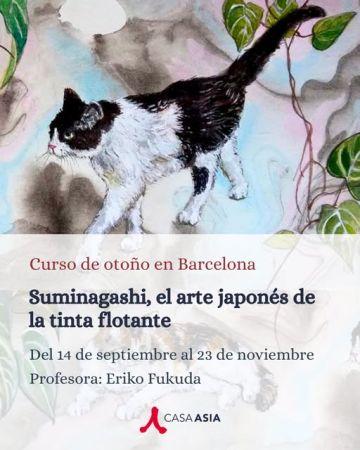
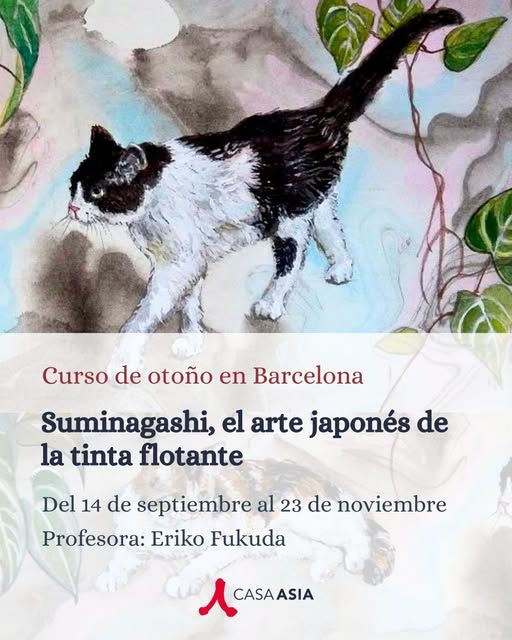
Suminagashi (墨流し), which can be translated as “floating ink,” is a traditional Japanese artistic practice and one of the first known forms of marbrejat on paper. Its origin dates back to the Heian period (794-1185) and is based on the creation of ephemeral compositions involving the interaction between ink and water.
This course offers an introduction to Japanese watercolor, this ancient technique, inviting participants to experience both the behavior of color on water. Through practical exercises, the relationship between fluidity, balance and gestation will be explored, to develop a special sensitivity to the changing nature of each composition.
Program:
Sessions 1 to 3: Introduction to Japanese aquarel and suminagashi
In these first sessions the foundations of all technical dues will be addressed, including materials, history and basic principles. It will work with water, ink and transparency, together with observation and composition exercises inspired by Japanese aesthetics.
Sessions 4 to 7: Practice and technical exploration
It will go into depth in the management of aquarel·la and the suminagashi mitjançant exercicis pàctics. Participants will explore the behavior of color, the creation of textures, layers and different expressive possibilities, experimenting with color and control of composition.
Sessions 8 to 10: Personal project development
These sessions will be dedicated to the creation of a personal project. It combines technical approaches in an experimental way, exploring different supports and contemporary applications, with the objective of developing its own artistic purpose.
Materials (included in the price):
– Japanese aquarels
– Paper d'aquarel·la
– Pallets
– Cubilets
Materials (to the student)
– Llapis number 2B or 3B
– Eraser
– 2 aquarel pinzells:
·Pinzell number 2, 6 or 8
Professor:
Eriko Fukuda moved to Kyoto, Japan, in 1979. He began painting at the age of 11 at an art school for children. He graduated from the Saga University of Fine Arts in Kyoto, Japan, where he studied from 1997 to 1999. After arriving in Barcelona, he studied at the Massana School from 2004 to 2007. During this period, he began to work on a concept highly linked to Japanese culture and the way of understanding and observing nature, so different from the manner of European veure. It introduces human cares, works in space and uses languages and materials typical of its culture, such as aquarel·la Gansai and Japanese pinzells.
After starting to paint with Japanese watercolor, he worked in a temple painting conservation and restoration company: Kyosaishiki Nakajima in Kyoto, Japan, handling and using Nihonga materials. Subsequently, she graduated from the University of Fine Arts of Barcelona between 2010 and 2013. Since 2017, she began teaching Japanese watercolor classes in different locations in Barcelona and Naples, Italy. You are currently studying at Mercantic, Sant Cugat del Vallès.